Posts

Chromatography for Plant Pigments

Image
  Chromatography For Plant Pigments by  Anchrom Lab  |  Sep 1, 2022 How chromatography is used to study plant pigments ? Words ‘Plant pigments’ and ‘chromatography’ reminds us of the beginning of chromatographic science. A Russian Botanist ‘Mikhail Tsvet’ invented chromatography in 19 th  century during his research on separation of plant pigments.  Tsvet had managed to separate a mixture of plant pigments, including chlorophyll, on a column packed with finely ground calcium carbonate, using petroleum ether as the mobile phase. Natural pigments such as chlorophylls, chlorophyll derivatives, xanthophylls, carotenoids, anthocyanins, betacyanin’s are abundant in plants or plant derived products.  Plant parts such as coloured flowers and fruits are because of carotenoids, flavonoids, anthocyanins or betalains. There are two main groups of betalains, the red-violet betacyanins and the yellow betaxanthins. Anthocyanins can be extracted by using solvent like ...

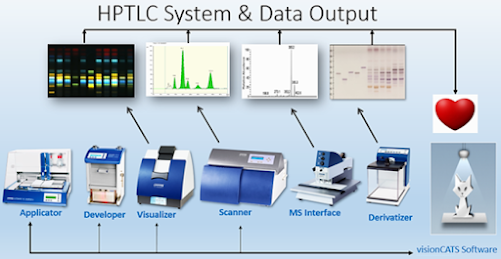
Why HPTLC Is The Best Choice For Analysis Of Herbal Samples?

Image
  Why HPTLC Is The Best Choice For Analysis Of Herbal Samples? HPTLC Method for Herbal Medicines Herbal medicines are drugs which are originated from herbal ingredients. As herbal medicines are complex mixtures of many different types of components, it is very difficult and challenging task to analyze them. Quality control, authenticity of the samples/products, safety concerns are difficult questions to answer affecting a huge market and covering many fields of herbal industry like Nutraceutical, Ayurvedic drugs, dietary supplements, Siddha drugs, Homeopathic drugs etc. When herbal samples are in raw material form i.e., crude drug in the form of flowers, fruit, stem, root or leaves it is possible to identify the same by means of macroscopic and microscopic characteristics. However, this type of study does not give much information about its chemical composition other than its authenticity or identity. This composition can be affected by age, environmental factors such as mineral nu...

Why Would One Use TLC Over Paper Chromatography?

Image
  Chromatography technique that uses paper sheets or strips as the adsorbent being the stationary phase through which a solution is made to pass is called paper chromatography. It is an inexpensive method of separating dissolved chemical substances by their different migration rates across the sheets of paper. Although paper chromatography technique is simple and rapid, uses minimum amount of material, comparatively less expensive than other chromatographic technique it has many disadvantages. Paper chromatography is useful only for qualitative evaluation. It has limitation to separate complex mixtures. The main differences between TLC and paper chromatography are: The principle behind thin-layer chromatography is based on adsorption. On the other hand, the principle of paper chromatography is based on partition. TLC analysis provides better separation for the components in the mixture and more useful chromatograms than paper chromatography. However, basic TLC has many limitations ...

What Are Alkaloids?

Image
  What are alkaloids? Alkaloids are a class of basic, naturally occurring organic compounds that contain at least one nitrogen atom.  Alkaloids have  diverse  and important physiological effects on humans and other animals. Well-known alkaloids include  morphine ,  strychnine ,  quinine ,  ephedrine , and  nicotine , piperine, caffeine etc. Many alkaloids have commercial importance as they have different medicinal properties. Alkaloids are found primarily in  plants  and are especially common in certain families of flowering plants.   Alkaloid names generally end in the suffix  -ine , a reference to their chemical classification as amines. In their pure form most alkaloids are colourless, non-volatile, crystalline  solids . Methods for extraction of alkaloids: Alkaloids can be extracted from plant tissues using weak acidic solvents and can then be selectively precipitated from such extracts using ammonia. Alkaloids ca...

Thin Layer Chromatography (TLC) - Principle, procedure

Image
    Thin Layer Chromatography TLC Principle Procedure     What is Chromatography? Chromatography means the separation of mixture of compounds. The components travel through a stationary phase at different speeds and get separated. The mixture is dissolved in the mobile phase and is carried through the stationary phase. Thin Layer chromatography is a form of planar chromatography. The stationary phase is a TLC plate (silica gel) or alumina. The plate is run through a solvent which is known as the mobile phase. The principle of TLC is  where mixture components are separated between a fixed stationary phase and a liquid mobile phase by differential affinities between the two phases. The separation is through adsorption. Thin-layer chromatography can be used to monitor the progress of a reaction, identify compounds present in a given mixture, and determine the purity of a substance.   What is High-Performance Thin Layer Chromatography? HPTLC (Hi...

What is the purpose of chromatography in biological research?

Image
  Chromatography is used to separate mixtures. This separation technique is important to life science industry. It is used to identify and quantify the metabolites such as pigments, proteins, blood samples, viscera samples. Varied chromatographic techniques are available. HPTLC  is a versatile technique which can be used in wide area of applications. Low-cost HPTLC is the major reason why chromatographers are switching to HPTLC.   Let us learn about the  HPTLC chromatography application  in biological studies. Biological studies include analysing compounds such as amino acids, lipids, carbohydrates, bile acids, vitamins, in blood samples, urine samples and viscera samples.   Sample preparation is the main step. Removing interferences is important and crucial step of any chromatographic analysis. HPTLC proves to be right choice for such analysis. We can change as many HPTLC layers (stationary phase) as we want as they are disposable. HPTLC can be used to ide...

What Are The Advantages Of Thin Layer Chromatography?

Image
Thin Layer Chromatography (TLC)  is a separation technique used to separate compounds in a mixture. It is based on the principle  of separation through adsorption type. Let us learn about the advantages of Thin Layer Chromatography and compare them with other chromatographic techniques. It is a  cost-effective technique, fast and simple  to use the technique. According to USP 203 Chapter, we can apply 15 samples on one 20x10 cm HPTLC plate. This allows us to simultaneously analyze 15 samples in one go. HPTLC  vs Liquid Chromatography  - Being an open technique, it is robust and does not damage the system as the plates are disposable this gives you an advantage over HPLC. In HPLC, the columns can have a carry-over effect if not cleaned properly. HPTLC is hassle-free and fast. HPTLC vs Gas Chromatography  - Gas chromatography is used to analyze volatile compounds whereas HPTLC is used for non-volatile compounds. HPTLC vs Paper Chromatography  - HPTL...